
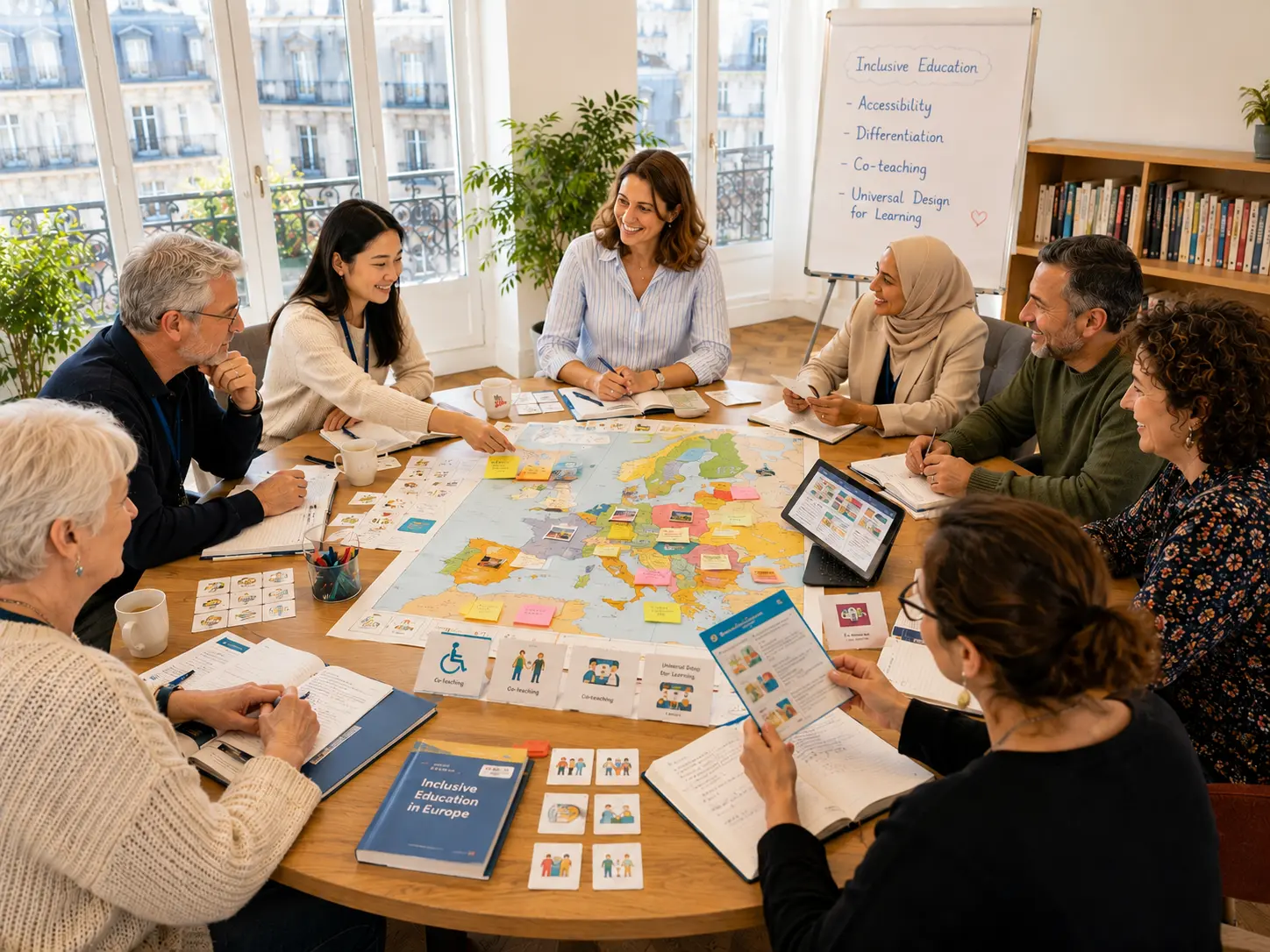
Inclusive education in Europe: teacher training course
Compare how European systems build inclusive schools, an Erasmus+ week in Bordeaux to learn from different national practices and bring the best ideas home.
Plan your Erasmus mobilityInclusive education in Europe course · Part of our Erasmus+ teacher training courses in Bordeaux
Across Europe, schools pursue the same goal of inclusion in very different ways. Understanding those differences, and what works, is one of the most valuable things a teacher can gain from an international mobility.
This Erasmus+ course looks at inclusive education from a comparative, European perspective: policies, models and classroom realities in different countries. It focuses on ideas you can adapt, complementing our practical inclusive education course on classroom strategies.
Why compare inclusion across Europe?
- Learn from difference: see how other systems solve challenges you also face.
- Question your own practice: comparison reveals assumptions and opens new options.
- Build European networks: exchange with colleagues facing inclusion from other angles.
- Bring ideas home: identify transferable practices that fit your own school context.
What you will learn about inclusive education in Europe
- Compare inclusive education policies and models across European countries.
- Analyse how different systems support SEN, migrant and disadvantaged learners.
- Identify strengths and limits of each approach for your own context.
- Translate international practice into concrete classroom actions.
What you will be able to do after this course
- Situate your national approach within the wider European picture.
- Select international practices that are realistic to adapt at home.
- Contribute a European dimension to your school’s inclusion strategy.
- Sustain exchange with the colleagues you meet during the mobility.
Explore the course in detail
Objectives, content and programme
This course takes a European perspective on inclusion: rather than one classroom toolkit, it compares how different education systems approach diversity, special needs and equity.
The aim is to broaden your frame of reference, learn from other countries’ policies and practices, and bring back ideas adapted to your own context.
By the end you will understand the main European models of inclusive education, be able to compare policies and practices critically, and identify transferable ideas for your school.
You will also build a network of colleagues across Europe for future exchange and Erasmus+ projects.
The course is built on comparison and exchange: case studies from several countries, structured discussion within an international group, and guided reflection on what would work in your setting.
Each session pairs a European theme, policy, funding, teacher roles, family involvement, with practical examples brought by participants.
Each day follows the same thread: understand, experience, design and transfer.
Monday: understanding inclusion across Europe
Morning
- Key European frameworks and terminology
- How systems define and organise inclusion
Afternoon
- Workshop: comparing two national approaches
- Build a comparison grid
Tuesday: special needs and support models
Morning
- Different models of support across countries
- The role of teachers, families and specialists
Afternoon
- Collaborative case studies from several systems
- Identify transferable ideas
Wednesday: equity, migration and multilingual classrooms
Morning
- Equity and diversity in European classrooms
- Supporting migrant and multilingual learners
Afternoon
- Adapt a practice to your own context
- Peer discussion and feedback
Thursday: from comparison to your school
Morning
- Turning European ideas into local action
- Building a European dimension in your school
Afternoon
- Hands-on workshop: design a transfer plan
- Collaborative review and improvement
Friday: building cooperation
Morning
- Demonstrations and exchange of European practices
- Reflecting on what works across systems
Afternoon
- Final project presentation
- Personal action plan and future partnerships
- Course evaluation, Europass and certification
Approach, impact and practical details
Comparing systems reveals that no single model is perfect, but recurring ingredients matter: early support, teacher collaboration and flexible curricula.
Seeing these ingredients at work in different countries helps you separate what is culturally specific from what is genuinely transferable.
Our comparisons draw on Eurydice’s comparisons of European education systems.
You gain a set of lenses for analysing any inclusive practice and adapting it, asking what conditions make it work and how to translate it into your own school’s reality.
The international group itself becomes a resource, turning diverse experience into practical ideas.
A comparative mobility strengthens both your teaching and your school’s European strategy, feeding policy discussions, project applications and partnerships.
This course is part of our Erasmus teacher training courses in Bordeaux and is a natural starting point for cross-border cooperation on inclusion.
We assist with your Learning Agreement and preparation, and you follow a clear, documented programme on site.
On completion you receive your Europass Mobility certificate, an evaluation and any documentation your National Agency needs for recognition.
Bordeaux, at the crossroads of European educational exchange, offers an inspiring and neutral ground to compare practices with colleagues from many countries.
Its accessibility and quality of life make it an ideal host city for international teacher mobility.
Target audience
This comparative course suits teachers, school leaders and support staff with an interest in the European dimension of inclusion, including trainers, educational and career counsellors, school psychologists, headteachers, school leaders and administrative staff. Participants arrive from primary, secondary, vocational and adult education, training centres, higher education and NGOs across different countries, so groups are deliberately diverse in both level and system.
Erasmus+ funding: how it works
Teachers, trainers, headteachers, school leaders and other members of education organisations can apply for an Erasmus+ KA1 grant, so your institution may cover travel, board and lodging, cultural activities and the fees of this inclusive education in Europe course through the grant.
As with all our programmes, the course is tailored to fit the Erasmus+ grant, and we offer a choice of options so quality and comfort never push you over budget.
Erasmus+ quality standards
Following the Erasmus Quality Standards, we give you a description of the course and its outcomes, the dates and venue, and the names of the provider and trainers before you travel.
Certification and the validation of learning outcomes are supported at every step, with attention to European instruments and Erasmus+ requirements; on request we add certification or reporting documents, photos and a short sum-up video to help you disseminate results.
Quality standards for our courses
- European values and policies
- Composition of the group and networking opportunities
- High quality teaching
- Inspiring and interactive learning
- Trustworthy, innovative and relevant content
- Use of digital tools and blended learning
- Continued learning
- Facilitating institutional impact
- Certification of learning outcomes
- Advance and complete information about the course
- Straightforward application process
- Preparation
- Transparent costs
- Changes and cancellations
- Support before, during and after the course
- Qualified staff
- Proportionate duration and schedule of the course
- Appropriate venue
- Inclusion
- Feedback and assessment
Our Erasmus+ organisational quality standards
- Practical arrangements
- Health, safety and respect of applicable regulations
- Preparation
- Monitoring and mentoring
- Support during the activity
- Evaluation and recognition of learning outcomes
- Core tasks, keeping ownership of the activities
- Integrating results of mobility activities in the organisation
- Developing capacity
- Regular updates
- Gathering and using participants’ feedback
- Sharing results within the organisation
- Sharing results with other organisations and the public
- Publicly acknowledging European Union funding
- Inclusion and diversity
- Digital education
- Active participation in the network of Erasmus organisations
- Environmental sustainability and responsibility
What is included in the course
- Support throughout: day-long chat assistance
- Covered by Erasmus+: eligible for KA1 mobility grants
- Change with ease: flexible options and few restrictions
- A full journey: coffee breaks, networking and cultural visits
- Certificate of attendance provided
Official Erasmus+ validation
To ensure the recognition of your inclusive education in Europe course, we provide all required European certification and Erasmus+ compliance documentation:
- ✓ Europass Mobility: Official recognition of your professional development and teaching skills.
- ✓ Quality Commitment: Full compliance with Erasmus+ quality standards.
- ✓ Final Certification: Official certificate of attendance with training hours.
Social & cultural programme
Your Erasmus+ teacher mobility in Bordeaux is also an opportunity to experience French culture and build connections with other European teachers.
- ✓ Welcome aperitif: Network with European colleagues in a relaxed setting.
- ✓ Guided city tour: Discover Bordeaux’s UNESCO World Heritage sites.
- ✓ Local recommendations: Explore the best markets, cafés and cultural spots.
Optional premium add-ons can be arranged on request on Saturdays (e.g. Arcachon Bay & the Dune du Pilat, or a Médoc / Saint-Émilion château; other options available according to your interest).
Erasmus+ teacher mobility in Bordeaux
Discover inclusive education across Europe
Join colleagues from across Europe in Bordeaux and bring the best inclusion ideas back to your school.
Start my projectFrequently asked questions
Yes. As a KA1-eligible course, an Erasmus+ grant can cover travel, board and lodging and the course fees, depending on your project.
No. It combines comparison of European systems with practical, transferable ideas you can adapt to your own school.
Teachers, school leaders and support staff interested in the European dimension of inclusion; participants come from several countries.
You receive a Europass Mobility certificate and a certificate of attendance; the course runs one week in Bordeaux, in groups of up to 16.
Teachers’ zone
Our online programmes let you maximise your learning potential and bring your new skills straight into your everyday teaching. Participants also get virtual classroom access.