Neuroscience and educational practice: understanding the young child's brain
An Erasmus+ week in Bordeaux where educators explore what brain science reveals about early learning, and turn it into everyday practice that helps children thrive.
Plan your Erasmus mobilityNeuroscience and educational practice course for teachers · Part of our Erasmus+ teacher training courses in Bordeaux
How does a young child’s brain actually learn? Neuroscience now gives educators concrete answers, and practical ways to act on them. This course bridges the gap between brain research and daily educational practice.
This Erasmus+ course in Bordeaux helps early-years and primary educators understand the mechanisms of early learning and adjust their everyday gestures to support every child. It sits within our wider Erasmus+ teacher training courses.
Why neuroscience matters in education?
- Understand behaviour: many everyday reactions make sense once you know how the young brain works.
- Support real learning: teaching aligned with how the brain learns is more effective and less tiring.
- Build shared references: a common, evidence-based language strengthens consistency across a team.
- Care for wellbeing: understanding stress, attention and emotion helps you create a calm, secure setting.
What you will learn about neuroscience and educational practice
- What neuroscience reveals about the functioning of the young child’s brain.
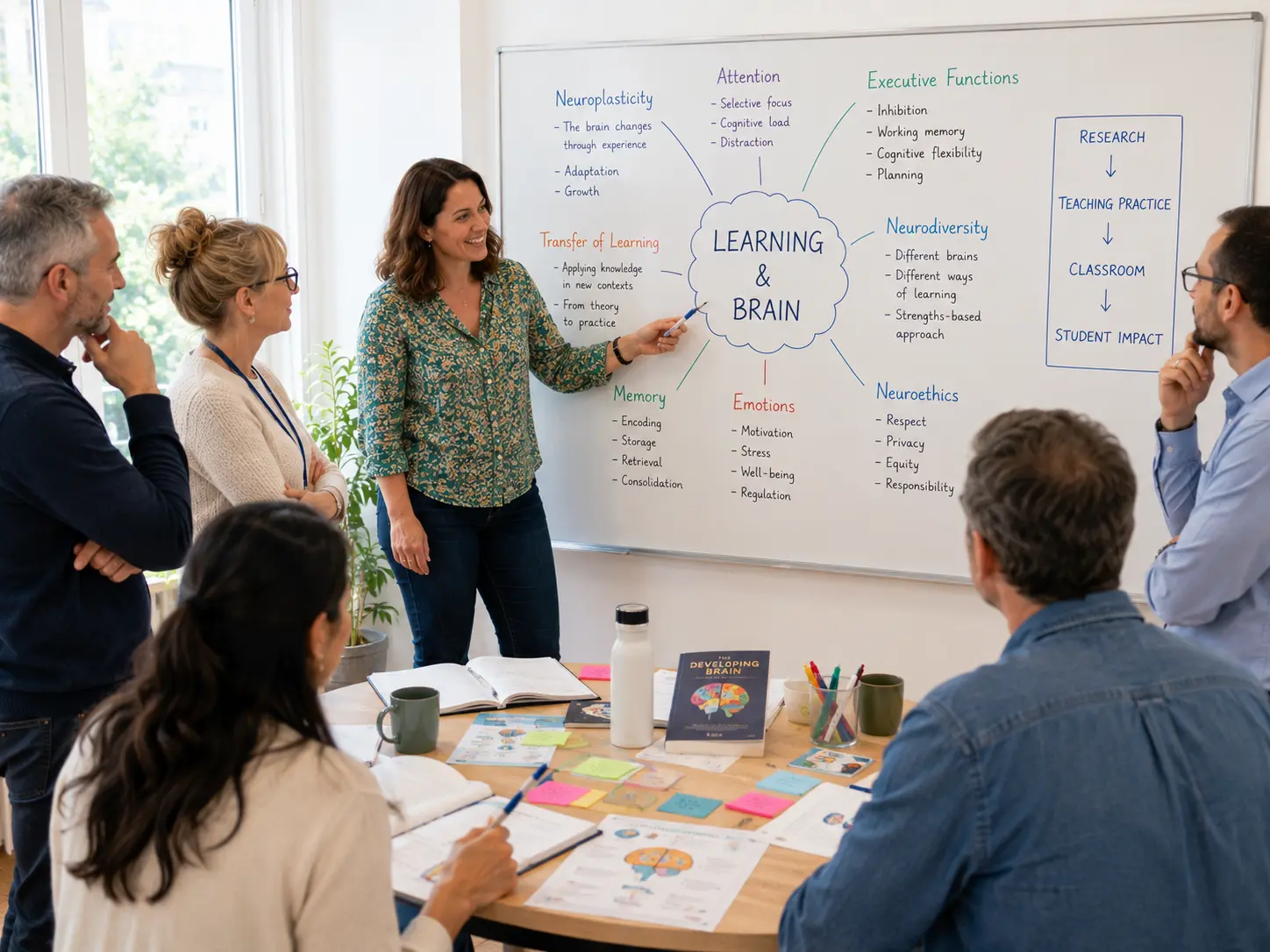
- The main mechanisms of early learning: attention, memory, emotion and repetition.
- How to adjust your professional gestures in everyday situations to support learning.
- How to read certain child behaviours in the light of neuroscience.
What you will be able to do after this course
- Explain, in simple terms, how the young child’s brain develops and learns.
- Adapt your daily routines and activities to the child’s stage of development.
- Respond to challenging behaviours with understanding rather than assumptions.
- Share clear, common reference points on child development with your team.
Explore the course in detail
Objectives, content and programme
This course helps educators understand what neuroscience reveals about the young child’s brain and translate it into everyday practice. You will explore the main mechanisms of early learning and learn to adjust your professional gestures to support them.
The aim is practical: to decode certain child behaviours in the light of neuroscience and create conditions that genuinely favour learning.
By the end you will be able to describe how the young child’s brain develops, identify the key mechanisms of early learning, and adapt your daily practice accordingly.
You will also be equipped to explain these ideas to colleagues and families, building shared reference points on child development.
The course combines theoretical input, always illustrated with concrete examples, with case studies and the analysis of professional practice.
You experience an active, reflective approach: short inputs are immediately linked to real situations from early-years and school settings.
Each day follows the same thread: understand, experience, design and transfer.
Monday: understanding how the brain learns
Morning
- How the brain learns: key neuroscience principles every teacher should know
- Neuromyths versus scientific evidence
Afternoon
- Interactive workshop: analysing everyday classroom situations through a neuroscience lens
- Create a "brain-friendly classroom" checklist for your own teaching
Tuesday: attention, memory and lasting learning
Morning
- Why children forget, and how to help them remember
- Attention, cognitive load and retrieval practice
Afternoon
- Design practical classroom activities that strengthen attention and long-term memory
- Test and adapt activities with fellow European teachers
Wednesday: motivation, emotions and neurodiversity
Morning
- The role of emotions in learning
- Understanding neurodiversity: ADHD, autism, dyslexia and gifted learners from a neuroscience perspective
Afternoon
- Collaborative case studies
- Adapt existing lessons to better support diverse learners
- Peer feedback and discussion
Thursday: from neuroscience to everyday teaching
Morning
- Turning research into practical classroom strategies
- Designing learning environments that support executive functions, autonomy and engagement
Afternoon
- Hands-on workshop: redesign one of your own lessons using neuroscience-informed principles
- Collaborative review and improvement
Friday: building your neuroscience-informed classroom
Morning
- Lesson demonstrations and exchange of European practices
- Reflecting on what works across different educational systems
Afternoon
- Final project presentation
- Personal action plan for implementation in your school
- Course evaluation, Europass and certification
Approach, impact and practical details
What consistently helps is small, evidence-based adjustments, not jargon: protecting attention, allowing repetition, and reducing stress so the brain is ready to learn.
We test these ideas on real situations, so you leave with practical responses you can use straight away. For deeper background, see the Harvard Center on the Developing Child.
You gain concrete, transferable gestures, how you phrase instructions, structure routines and respond to emotion, that align daily practice with how young children learn.
These approaches are realistic and low-preparation, designed for busy early-years and school settings.
Beyond the week, the course strengthens educational consistency within your team through shared reference points on child development.
This course is part of our Erasmus teacher training courses in Bordeaux, and it helps create environments, and a quality of support for children and families, that genuinely favour learning.
We help you prepare your Learning Agreement and logistics beforehand, and you follow a clear, documented programme during the week.
Afterwards you receive your Europass Mobility certificate, an evaluation and any additional documents your National Agency requires for recognition.
Bordeaux offers a calm, human-scale setting and a rich educational network, ideal for reflecting on how children learn.
Well connected across Europe, it makes teacher mobility easy to organise and genuinely enriching.
Target audience
This course is aimed at early-years and primary educators, and more broadly at teachers, trainers, educational and career counsellors, school psychologists, headteachers, school leaders and administrative staff. It suits anyone working with young children, in nurseries, early-years and primary settings, childcare structures, training centres and NGOs, and groups often bring together several types of setting.
Erasmus+ funding: how it works
Teachers, trainers, headteachers, school leaders and any staff of an education organisation can apply for an Erasmus+ KA1 grant, so your institution may cover travel, accommodation, meals, cultural activities and the fees of this neuroscience and educational practice course through the grant.
Because the pricing is aligned with the Erasmus+ grant, you can choose the options that suit you and still remain within your funding.
Erasmus+ quality standards
This course is delivered in line with the Erasmus Quality Standards: for every session we provide a clear description and its learning outcomes, the dates, the venue and the names of the provider and trainers.
We support you through certification and the validation of learning outcomes, from the Learning Agreement to the Europass Mobility certificate, and can provide additional certification or reporting documents, plus photos and a short video, on request for visibility and dissemination.
Quality standards for our courses
- European values and policies
- Composition of the group and networking opportunities
- High quality teaching
- Inspiring and interactive learning
- Trustworthy, innovative and relevant content
- Use of digital tools and blended learning
- Continued learning
- Facilitating institutional impact
- Certification of learning outcomes
- Advance and complete information about the course
- Straightforward application process
- Preparation
- Transparent costs
- Changes and cancellations
- Support before, during and after the course
- Qualified staff
- Proportionate duration and schedule of the course
- Appropriate venue
- Inclusion
- Feedback and assessment
Our Erasmus+ organisational quality standards
- Practical arrangements
- Health, safety and respect of applicable regulations
- Preparation
- Monitoring and mentoring
- Support during the activity
- Evaluation and recognition of learning outcomes
- Core tasks, keeping ownership of the activities
- Integrating results of mobility activities in the organisation
- Developing capacity
- Regular updates
- Gathering and using participants’ feedback
- Sharing results within the organisation
- Sharing results with other organisations and the public
- Publicly acknowledging European Union funding
- Inclusion and diversity
- Digital education
- Active participation in the network of Erasmus organisations
- Environmental sustainability and responsibility
What is included in the course
- Guidance throughout: full-day support during the course
- Erasmus+ fundable: eligible for Erasmus+ KA1 grants
- Flexible arrangements: easy changes with minimal restrictions
- A complete week: from coffee breaks to cultural visits
- Certificate of attendance
Official Erasmus+ validation
To ensure the recognition of your neuroscience and educational practice course, we provide all required European certification and Erasmus+ compliance documentation:
- ✓ Europass Mobility: Official recognition of your professional development and teaching skills.
- ✓ Quality Commitment: Full compliance with Erasmus+ quality standards.
- ✓ Final Certification: Official certificate of attendance with training hours.
Social & cultural programme
Your Erasmus+ teacher mobility in Bordeaux is also an opportunity to experience French culture and build connections with other European teachers.
- ✓ Welcome aperitif: Network with European colleagues in a relaxed setting.
- ✓ Guided city tour: Discover Bordeaux’s UNESCO World Heritage sites.
- ✓ Local recommendations: Explore the best markets, cafés and cultural spots.
Optional premium add-ons can be arranged on request on Saturdays (e.g. Arcachon Bay & the Dune du Pilat, or a Médoc / Saint-Émilion château; other options available according to your interest).
Erasmus+ teacher mobility in Bordeaux
Re-energise your teaching in Bordeaux
Join our Erasmus+ course and leave with active, creative methods you can use from your very next lesson.
Start my projectFrequently asked questions
Yes. It is fully KA1-eligible, so an Erasmus+ grant can cover travel, accommodation, meals and course fees.
No. Neuroscience is presented in plain language and always illustrated with concrete examples from everyday practice.
Yes. It centres on the young child's brain and early learning, and suits early-years and primary educators in particular.
You receive a Europass Mobility certificate and a certificate of attendance; the course runs one week in Bordeaux, in groups of up to 16.
Yes. The course helps educators understand attention, emotion, stress and self-regulation, so they can respond to everyday behaviour with more appropriate and supportive strategies.
Teachers’ zone
Our online programmes let you maximise your learning potential and bring your new skills straight into your everyday teaching. Participants also get virtual classroom access.